
Indian stock markets, including the Sensex and Nifty, rebounded significantly, driven by a decline in crude oil prices and positive global cues stemming from hopes of diplomatic progress in US-Iran negotiations.

Indian equity benchmarks Sensex and Nifty surged nearly 1 per cent, driven by strong earnings reports from FMCG and auto sectors, alongside a rally in Asian markets and signs of de-escalation in geopolitical tensions.

Indian equities are experiencing their sharpest rebound in years, with the BSE 500 index rallying 12.1 per cent so far this month, echoing Covid-era recoveries despite ongoing geopolitical uncertainty and earnings risks.
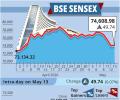
Indian benchmark equity indices, Sensex and Nifty, closed marginally higher, breaking a four-day losing streak, despite elevated crude oil prices and ongoing geopolitical uncertainties. The market saw a temporary pause in panic selling, though cautious sentiment persists.

Indian stock market benchmark indices closed higher, driven by strong performance in blue-chip bank shares and a positive trend in global markets, with hopes of progress in US-Iran peace negotiations also contributing to optimism.
Indian benchmark stock indices Sensex and Nifty rebounded nearly 1 per cent, snapping a three-day decline, driven by rallies in Reliance Industries and Sun Pharma, alongside positive global market trends and easing geopolitical tensions.
Indian stock markets extended their gains for a third consecutive day, with the Sensex climbing 753 points and the Nifty closing above 24,550, driven by a drop in crude oil prices and optimism surrounding potential peace talks between Iran and the US.

Indian benchmark equity indices Sensex and Nifty closed higher, recovering from previous losses, driven by a global market rebound, a pause in Israel-Iran hostilities, and a rally in bank stocks.
Indian benchmark indices Sensex and Nifty rebounded in early trade, recovering from previous losses, driven by softening crude oil prices and renewed buying interest in blue-chip stocks. Analysts note that the fall in Brent crude below USD 77 has removed significant macro headwinds for India, contributing to market stability.
Indian benchmark indices Sensex and Nifty rebounded in early trade, driven by strong buying in blue-chip stocks and positive cues from Asian markets, following a significant selloff in the previous session.
Indian benchmark indices Sensex and Nifty rebounded in early trade, tracking a recovery in global equity markets and an easing of hostilities between Israel and Iran, after a sharp fall in the previous session.
Indian equity benchmark indices Sensex and Nifty rebounded in early trade, driven by buying in blue-chip stocks and a positive trend in Asian markets, with domestic institutional investors providing crucial support.
Indian benchmark equity indices, Sensex and Nifty, rebounded on Wednesday, recovering intraday losses, primarily driven by strong fag-end buying and a significant rally in blue-chip Reliance Industries.

Indian benchmark equity indices, Sensex and Nifty, rebounded nearly 1 per cent, with the Sensex jumping 790.54 points to 76,991.22, driven by softening crude oil prices and strong buying in banking, financial, and IT shares.

Indian benchmark indices, the BSE Sensex and NSE Nifty, snapped a four-day losing streak, with the Sensex climbing 382 points, primarily driven by a strong rally in IT sector shares. Major IT firms like TCS, Infosys, and HCL Tech saw significant gains, contributing to the market's recovery.

Trent reported a 20 per cent revenue rebound in Q4FY26, driven by a recovery in like-for-like growth and significant store additions. The company's board has approved raising up to 2,500 crore in equity to fund investments in store network upgrades, new brands, supply chain automation, and Star Bazaar expansion, alongside a 1:2 bonus issue and a 6 dividend.

Indian benchmark indices, Sensex and Nifty, saw a significant rebound in early trade, driven by a decline in crude oil prices. This drop followed US President Donald Trump's announcement of progress in negotiations with Iran towards an agreement to end the war, leading to a temporary pause in 'Project Freedom' to escort ships through the Strait of Hormuz. Track Nifty 50 and BSE Sensex performance and key global triggers.

Stock markets rebounded on Friday with the benchmark Sensex closing higher by 316 points after heavy buying in banking and metal shares amid optimism over trade deal progresses and India's participation in Pax Silica.
Indian stock markets recovered from early losses to close higher, driven by value buying in IT and banking shares and a rebound in the rupee.

In April alone, they snapped up shares worth Rs 19,664 crore, recording their biggest buy since October 2024.
Indian benchmark indices Sensex and Nifty rebounded in early trade after three days of decline, driven by a rally in Sun Pharma following its USD 11.75 billion acquisition of US-based Organon & Co, alongside a positive trend in global equity markets.
The Indian rupee rebounded 50 paise from its all-time closing low to settle at 96.36 against the US dollar, driven by retreating crude oil prices, signs of easing geopolitical friction, and likely central bank intervention.

Indian benchmark indices Sensex and Nifty surged over 1 per cent, with the Sensex jumping 918.60 points, driven by strong buying in banking and financial counters and a positive trend in global equities, fuelled by hopes of easing West Asia tensions.

Indian benchmark indices Sensex and Nifty surged significantly in early trade, tracking a global rally fueled by US President Donald Trump's declaration of an end to the war with Iran and a subsequent drop in crude oil prices.
Indian stock market benchmark indices Sensex and Nifty rebounded in early trade, driven by a decline in crude oil prices, supportive global cues, fresh foreign fund inflows, and buying in blue-chips like Reliance Industries and HDFC Bank. Track Sensex, Nifty movement on June 22, 2026.

After a robust 2023, foreign investors significantly scaled back their investments in Indian equities in 2024, with net inflows amounting to over Rs 5,000 crore, as elevated domestic valuations, coupled with geopolitical uncertainties prompted investors to adopt a more cautious stance. Looking ahead to 2025, FPI flows into Indian equities could see a recovery, supported by a cyclical upswing in corporate earnings, particularly in domestic-oriented sectors like capital goods, manufacturing, and infrastructure, Vinit Bolinjkar, head of research, Ventura Securities, said.

Indian benchmark indices Sensex and Nifty closed lower, snapping a two-day rally, as a spike in crude oil prices, triggered by reports of fresh US military operations in southern Iran, dampened investor sentiment and reignited fears of renewed energy supply disruptions.
Indian benchmark equity indices, Sensex and Nifty, saw a rebound in early trade, driven by a rally in global markets and easing Brent crude oil prices, with hopes of US-Iran peace negotiations also contributing to investor optimism. Track Sensex, Nifty on May 22

Trade deals ease risks for Indian equities, but weak demand and stretched valuations raise questions over whether optimism -- especially in smallcaps -- can turn into a sustained bull run, points out Debashis Basu.

The BSE benchmark traded 44.43 points up at 76,521.93, and the Nifty quoted 17.20 points higher at 24,048.85. Track Stock markets on May 26.

Listed capital market companies in India delivered strong fourth-quarter earnings growth, with a universe of 12 firms posting 30 per cent year-on-year revenue growth and 19 per cent earnings growth in Q4FY26, despite mark-to-market (MTM) losses impacting headline profitability for some.

Indian benchmark stock indices Sensex and Nifty rebounded, closing over 1% higher, mirroring a global equities recovery after recent losses due to geopolitical tensions.

Indian markets on Dalal Street rallied sharply as easing tensions in the US-Iran conflict and stable oil prices boosted sentiment. Track Nifty 50 and BSE Sensex performance and key global triggers.

Indian equity markets experienced a volatile session, with the Sensex and Nifty recovering some ground after a significant plunge the previous day. Gains were driven by PSU bank, IT, and metal stocks, but concerns over rising fuel prices and geopolitical tensions limited the recovery.
Indian markets on Dalal Street rallied sharply as easing tensions in the US-Iran conflict and stable oil prices boosted sentiment. Track Nifty 50 and BSE Sensex performance and key global triggers.

Foreign investors have withdrawn over Rs 88,000 crore from Indian equities this month, driven by geopolitical tensions, a weak rupee, and concerns about rising crude oil prices.

'FPIs are unlikely to return unless there is equilibrium between valuation premium and earnings growth.'

Foreign investors have withdrawn a record Rs 1.14 lakh crore from Indian equities in March, driven by geopolitical tensions, a weakening rupee, and concerns about crude oil prices.

'Once the market decides it wants to go up, it goes up -- no amount of bad news can really hold it back.'

After two months of net outflow, foreign investors turned buyers in June, infusing Rs 26,565 crore in Indian equities, driven by political stability and a sharp rebound in markets. Looking ahead, attention will gradually shift towards the budget and Q1 FY25 earnings, which could determine the sustainability of FPI flows, Vipul Bhowar, Director, Listed Investments, Waterfield Advisors, said.
